Before You Buy or Sell at the Beach, Ask “Why” First
A client of ours was recently trying to decide whether now was the right time to sell their place at the beach.
“Summer is over. Are there still buyers, or should we wait until spring?” they asked.
It’s a fair question. But before we can answer it, there’s a more important one: why do you own this property in the first place? And if you’re considering buying one, why do you want one?
Bottom line up front: who has the leverage in a real estate deal, and why the other side is really buying or selling, matters more than almost any single line-item problem that comes up during a transaction. Below: how to read leverage, how to read motivation, and what to do with both — plus, this week’s numbers on which local markets currently favor buyers and which still favor sellers.
This is this week’s Smart Beach Investor market report — subscribers get it first, every week
The Problem Determines the Solution
I asked our client whether the property was strictly an investment or whether they used it too.
“It’s an investment,” they said.
“Okay, so the goal is to keep it rented and generate as much return as possible?”
“Well, we like to use it too.”
As we talked, I learned they come down a couple of weeks each year with their whole family and occasionally use it when it isn’t rented. There it was. It’s not really a pure investment — it’s part investment, part lifestyle.
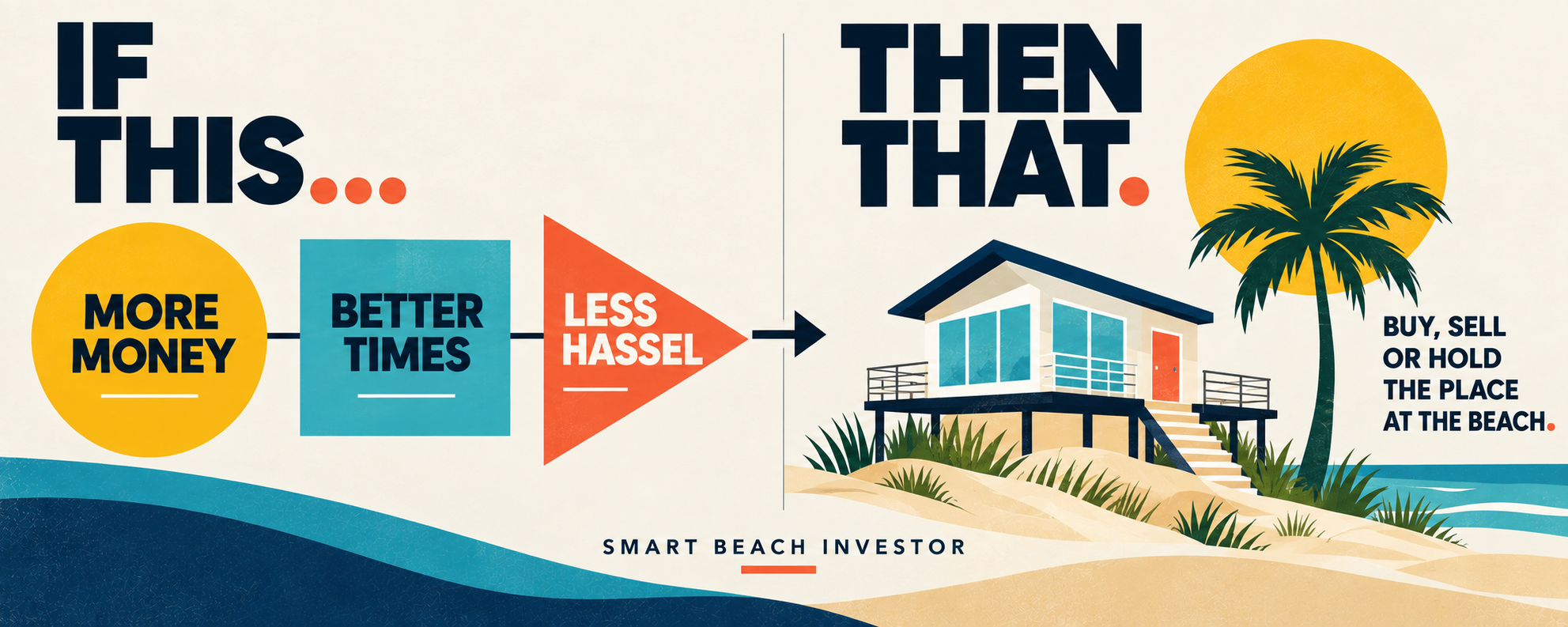
That distinction matters, because the reason you own a property should determine how you evaluate whether to keep it, sell it, or buy something different.
If it’s purely an investment, the decision is almost always financial:
- How much equity do you have tied up in the property?
- What return is that equity producing?
- What do you reasonably expect from rental income and appreciation going forward?
- Could that capital produce a better risk-adjusted return somewhere else — another property, the stock market, your business, paying down debt, or something entirely different?
If there’s a clear and better use for the capital, selling deserves serious consideration. If there isn’t, continuing to own the property may make more sense.
Most of the owners we work with don’t fit neatly into that category. Most want the property to perform financially and they want to use it — which means the property is producing two different kinds of returns:
The Financial Return: your rental income, potential appreciation, and the other financial benefits of ownership.
The Lifestyle Return: your family has a place at the beach. You can use it when you want, bring the kids and grandkids, and make memories there year after year.
The Lifestyle Return is tougher to put into a spreadsheet, but it definitely has value that needs to be considered.
Looking for a Property Where the Numbers Work?
Here’s one we’re looking at right now. Renters cover the mortgage and operating costs, and still send you about $34,000 a year.
- $1.75M Purchase Price
- $250,000 Gross Annual Revenue
- ~$133,000 Projected NOI
- 7.6% Projected Cap Rate
- ~$34,000 Projected Annual Cash Flow
- 7.8% Projected Cash-on-Cash Return
Wait — there’s more. Cash flow is only part of the return. Renters also pay down the loan (about $15,000 in year one and roughly $200,000 over 10 years), while the property appreciates on its full value, not just your down payment.
Projected equity after 10 years: ~$1.71M on $437,500 invested (based on the area’s 4.9% average annual appreciation since 1995; even at a conservative 3%, it’s ~$1.24M. Past performance doesn’t guarantee future results.)
Want to see the property — and exactly how we got to those numbers?

Do the Math
If you’re trying to decide whether to keep or sell a property, start by determining what you’d actually walk away with if you sold. Not the sales price — the capital you’d have left after paying off any debt, selling expenses, and potential tax consequences.
Then ask what that money could reasonably earn somewhere else. That’s the opportunity cost of leaving your equity tied up in the property.
Next, look at what the property is producing today: rental income, expenses, potential appreciation, owner use, and the other financial benefits and costs of ownership.
Then there’s the lifestyle side. If your family uses the property three weeks a year, what would it cost to rent a comparable — or even better — property for those same three weeks?
Now you’re making a much more useful comparison. You may discover owning the property still makes perfect sense. Or you may discover you could sell it, put the equity to better use, rent a great place whenever you want to visit, and come out ahead.
Hassle vs. Doing Nothing
There’s another factor that doesn’t fit neatly into the spreadsheet: hassle.
If you sell, then what? What do you do with the money? Do you buy something else, invest it, pay down debt, or consider a 1031 exchange? If you still want to vacation at the beach, where do you stay? Selling can solve one problem while creating several new decisions. There’s value in simplicity.
If you already own a property you love, it’s producing an acceptable return, your family enjoys it, and owning it isn’t creating headaches — doing nothing has value too.
The opposite can also be true. Maybe the property looks pretty good financially, but you’re tired of dealing with rentals, repairs, assessments, insurance, HOAs, or simply worrying about a property hundreds of miles away. Hassle has a cost, even if it never appears on your income statement.
Solve the Right Problem
This brings us to a question owners should ask before deciding to sell, particularly if the reason they’re considering it is poor rental performance or the headache of ownership:
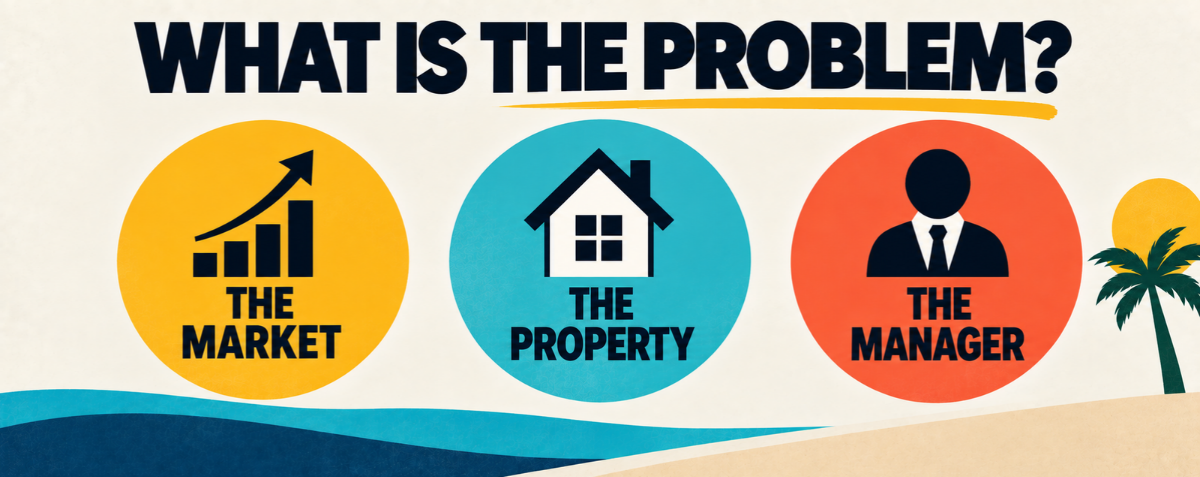
Is the problem the property — or the way it’s being managed?
Those aren’t necessarily the same thing. Maybe the rental strategy needs work. Maybe the property needs to be repositioned. Maybe the guest experience could be improved. Maybe the marketing isn’t good enough, or expenses need attention. Or maybe, after looking at everything objectively, the property simply isn’t capable of producing the return you need from the capital you have invested in it.
Those are very different problems with very different solutions. Before selling the asset, make sure the asset is actually the problem. Sometimes the better answer isn’t selling — it’s making what you already own work better. The same basic thinking applies if you’re considering buying a place at the beach.

Start With Why
If you’re wondering about buying or selling a property at the beach, simply start with why:
If your why is primarily an investment: we should be looking for properties where the potential return justifies the capital required and the risk you’re taking.
If your why is primarily a lifestyle play: the “best” property may simply be the one your family will use and enjoy the most — even if another property looks slightly better on a spreadsheet.
If it’s both — which I suspect describes a lot of owners we work with here at the beach — then we’re looking for the right balance: a property your family loves that also makes financial sense when you’re not using it.
Don’t start by asking “What should I buy?” Start by asking: “What do I need this property to do for me?”
Sellers: know how replaceable the buyer is. Rejecting a reasonable concession can become even more expensive if the property sits another three months, or the next offer is even lower.
Wondering how replaceable you are as a seller right now? We can run the numbers on your specific property and tell you.
Now, What Is the Market Telling Us?
Once you understand why you own — or want to own — a place at the beach, the original question becomes much easier to answer.
Your goal determines what matters. The market determines your options.
Now we can look at whether buyers are active, how much inventory is available, who has negotiating leverage, whether seller expectations are changing, and what properties are actually selling for. And perhaps most importantly, we can determine what’s happening in your particular building or neighborhood, and whether today’s market aligns with your goals.
See the Current Numbers by Market
This week’s report takes a closer look at Destin, where condos and houses are telling two very different stories:
Get This Analysis Every Week
Every week, subscribers get this indicator’s latest reading for their market — before it’s published here.

Final Thoughts
Whether you’re buying, selling, or holding, our job is to help you see your real position clearly — not guess at it.
- Buyers: Get notified when list price trends shift in your target market
- Sellers: Request a complimentary SaleAbility Analysis and pricing strategy
- Owners: Schedule a Rental Performance Review
Or reach our team directly at 850-654-3325 to talk through where you stand.
Committed to your success,
John Moran – CEO The Smart Beach Investor | Keller Williams Realty At The Beach Team