
How to Read Real Estate Market Signals (A $175K Lesson From 30A)
A guy laid into me on social media this week, telling me my real estate market signals were wrong and that I was giving people bad information. Turns out, we were both right — we were just looking at two different layers of the same market. Here’s the $175,000 lesson that came out of it, and how to apply it whether you’re buying, selling, or holding in Destin, 30A, or Panama City Beach.
This is this week’s Smart Beach Investor market report — subscribers get it first, every week

A Guy Called Me Out on Social Media — He Had a Point
My initial reaction was… let’s fight. I don’t give out wrong information — “where you get your information matters” is basically my whole shtick.
Here’s what happened: I’d posted a video reporting on condo sales across our three markets — Destin, 30A, and Panama City Beach. In it, I said 30A condo sales were up more than 57% compared to last year, median sales price was up almost 16%, and called it a seller’s market.
A guy pushed back hard: “If this is a seller’s market, why are sellers having to [cut their price $175,000]?”
That’s a pretty damn good question. And here’s the thing — the numbers weren’t wrong. We were just reading from different chapters of the same book.
He Was Seeing Something I Wasn’t
While I was looking at the entire 30A condo market, he was only looking at the one condo building he cared about. And what he was seeing didn’t look like a seller’s market at all.
- Condos in his building were sitting
- Sellers were reducing their asking prices
- One listing had been on the market roughly 190 days and had cut its price by $175,000
The Lesson: Real Estate Markets Have Layers
To get an accurate picture of what’s happening, you have to look through a series of layers — not just one:
- National — interest rates, lending, the economy
- Regional — Florida migration, insurance, tourism, regulation
- Local — Destin, 30A, or Panama City Beach
- Property type — condos or houses
- Building or neighborhood
- The individual property
Two condos in the same building can behave completely differently because of floor, view, condition, renovations, or rental performance. Two houses in the same neighborhood can behave differently because of location, floor plan, amenities, and condition. Knowing which details matter — and which don’t — can mean real money when you’re buying or selling, because every layer affects both value and leverage.

The Best Practice is to Keep Drilling Down:
- Good: What is the entire market telling us?
- Better: What is the specific building or neighborhood telling us?
- Best: What is the market telling us about the actual property I’m considering buying or selling?
The closer you get to the actual property, the more specific — and more useful — the information becomes.
Let’s Play This Out in the Real World
Across 30A, condo sales were up more than 57% and median price was up almost 16%. But at this guy’s building, the market was giving a completely different signal.
There were 7 condos listed for sale, and the typical listing had been sitting more than 100 days. The median sales price year to date was $925,000 — exactly where it was last year. Not up, not down.
Then a signal came through like a blinking neon sign on a dark night: a new listing hit the market at $850,000 and went under contract in just 2 days.
Seven condos for sale. Long days on market. A median sales price of $925,000. Then a seller comes in at $850,000 — the sign blinks. A buyer responds almost immediately — the sign blinks again. We don’t know what it will ultimately sell for, so we don’t have the final piece yet. But we know one thing: buyers responded to that price, fast. That’s how the market signals what’s actually happening.
Want a building-specific read instead of the market average? Request a free building-level analysis
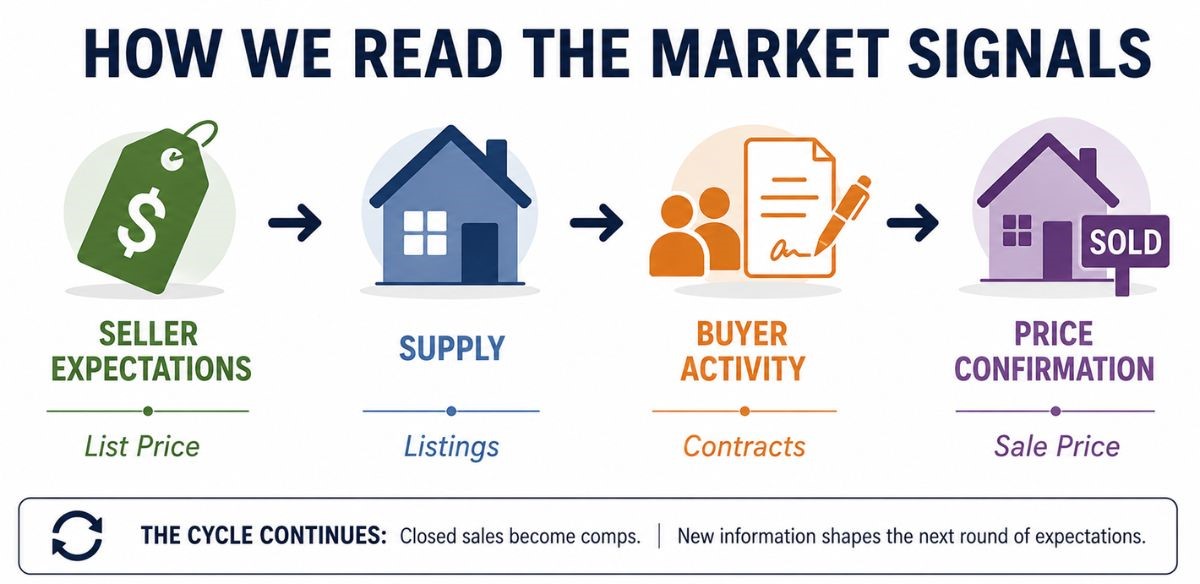
How to Use Real Estate Market Signals
If you’re buying: don’t assume sellers have all the leverage just because area-wide prices are up. Long days on market, multiple competing listings, and price reductions are telling you that you have negotiating leverage.
If you’re selling: don’t price based solely on what other sellers are asking. Pay attention to where buyers are actually responding, and know how your particular unit or home competes with everything else currently listed.
Because ultimately, that’s the real question: where’s the leverage, and how do you use it?
The Bottom Line
Even when the overall market is moving one direction, your particular neighborhood, building, or individual property can be moving another. The numbers are only the starting point. You can find real estate statistics almost anywhere — what’s harder is understanding what they’re telling you once you put them together.
That’s what we do at Smart Beach Investor. Every week we ask:
- What are we seeing?
- What is it signaling?
- Where is the leverage?
- What are we watching next?
See This Week’s Numbers by Market
The layers lesson above applies the same way in all three markets — but each one is signaling something different right now:

Get This Analysis Every Week
Every week, subscribers get this indicator’s latest reading for their market — before it’s published here.
Final Thoughts
Whether you’re buying, selling, or holding, our job is to help you see your real position clearly — not guess at it.
- Buyers: Get notified when list price trends shift in your target market
- Sellers: Request a complimentary SaleAbility Analysis and pricing strategy
- Owners: Schedule a Rental Performance Review
Or reach our team directly at 850-654-3325 to talk through where you stand.
Committed to your success, John Moran – CEO
The Smart Beach Investor | Keller Williams Realty At The Beach Team